
NEC 2026 EV Charger Requirements: Complete Compliance Guide
Table of Contents
- Understanding NEC 2026 EV Charger Requirements in Altadena, California
- New NEC 2026 Rules for EV Charger Installations in Altadena, California
- GFCI Protection Requirements for EV Circuits Under the 2026 Code in Altadena, California
- Who Qualifies as a ‘Qualified Person’ for EV Charger Installation in Altadena, California?
- Hardwired EV Charging: What the 2026 Electrical Code Mandates in Altadena, California
- Steps to a Code-Compliant EV Charger Installation in Altadena, California
- Ensuring Your EV Charger Meets 2026 Code Standards in Altadena, California
Understanding NEC 2026 EV charger requirements in Altadena, California
Understanding NEC 2026 EV charger requirements in Altadena is critical for any homeowner planning a new installation. The 2026 National Electrical Code introduces several updates that directly affect residential EV charger projects, and staying informed helps you avoid costly permit rejections and unsafe setups.
Any increase in electrical load often necessitates a panel upgrade, making it important for homeowners to understand electrical panel permit fees in California. As trusted local electricians in Altadena, we stay current with these code changes to ensure every installation meets the latest safety standards.
Key changes to the NEC 2026 update for EV charging include:
- A revised demand factor in Article 625 that can reduce required service size when multiple EVSEs are installed.
- Mandatory GFCI protection for all EV charging circuits per NEC 625.54, now extending to hardwired units in garages.
- A new rapid shutdown requirement (NEC 625.52) for chargers located close to building entrances.
- Altadena enforces the California Electrical Code, which adopts the NEC with state amendments; local inspectors may impose stricter conduit rules in garages.
With these requirements in mind, hiring a licensed electrician who understands the 2026 NEC update for EV charging ensures a safe, compliant installation and smooth permitting.
New NEC 2026 Rules for EV Charger Installations in Altadena, California
With the upcoming NEC 2026 EV charger requirements, several important changes will directly affect how homeowners in Altadena, California plan and install EV charging equipment. The NEC 2026 is the next edition of the National Electrical Code, expected to take effect in 2026; California may adopt it with state amendments on a delayed timeline, commonly in January 2027. Understanding these updates lets homeowners plan for permitting and installation.
- GFCI protection: NEC 2026 expands ground-fault circuit interrupter coverage to include all 125V and 240V EVSE receptacles and hardwired units. Most EV outlets and hardwired chargers in Altadena, California will require GFCI devices to reduce shock risk and meet new standard.
- Load calculations and service sizing: Updated load calculation methods explicitly account for EV charging demand, prompting electricians to reassess service capacity, panel loads, and circuit design. This can influence whether a dedicated circuit, feeder, or panel upgrade is recommended to support charging without nuisance trips.
- Disconnects and conduit guidance: NEC 2026 introduces new disconnect location requirements—often a local disconnect within sight of the EVSE—and updates conduit and raceway sizing rules to address heat and conductor derating for continuous charging loads. Installers will plan equipment placement, labeling, and conductor fill calculations to comply with safety and accessibility.
Local adoption and permits vary, so check with the Altadena building department before scheduling work. Our internal FAQ notes permit processing times depend on workload; accurate documentation speeds approvals. We recommend hiring licensed, insured electricians who stay current with code cycles to ensure compliance with the latest safety standards. As trusted local electricians, we provide EV charger installation, permitting support, and a free estimate. Should an unexpected problem arise, our 24/7 emergency electrician in Los Angeles team is ready to respond promptly. Always hire a licensed electrician and obtain the necessary permits for electrical work. Contact us to schedule an evaluation in Altadena, California.
GFCI Protection Requirements for EV Circuits Under the 2026 Code in Altadena, California
When reviewing NEC 2026 EV charger requirements, one of the most significant updates for Altadena, California homeowners is the expanded ground-fault circuit interrupter (GFCI) protection for electric vehicle supply equipment (EVSE). The 2026 code introduces stricter mandates designed to enhance safety and prevent electrical shock hazards in residential garages, carports, and outdoor charging locations.
Under NEC 625.54 and 210.8, all EVSE receptacles and hardwired connections rated between 125V and 250V, up to 50 amps, must now be GFCI-protected. This applies regardless of installation location—whether in a garage, carport, outdoors, or indoors—eliminating previous exceptions that allowed non-GFCI circuits in certain settings. In Altadena, where occasional rain and high humidity can increase moisture risks around outdoor charging stations, this requirement is especially important for preventing ground faults.
To comply with the NEC 2026 EV charger requirements, GFCI breakers are typically required for 240V Level 2 chargers rather than GFCI receptacles. The breaker must be rated for the specific circuit—commonly 50A for a 40A EV charger—and integrated into the main electrical panel. Our licensed electricians in Altadena ensure GFCI breaker selection matches the charger’s specifications and avoids nuisance tripping, which can occur with incompatible devices. They also verify that the panel can accommodate the necessary GFCI breaker without overloading. It’s important to note that existing EV circuits installed before the 2026 code adoption may be grandfathered, but any new installation or major upgrade must now include GFCI protection.
While GFCI protection primarily prevents electrical shock, it also mitigates broader electrical risks, such as common electrical issues in coastal homes, where corrosion can compromise safety. Although Altadena is inland, humidity and aging electrical panels can cause similar corrosion-related problems. GFCI technology adds an extra layer of protection by instantly cutting power when a fault is detected, reducing the chance of fire or injury.
With these GFCI requirements in mind, proper installation and panel readiness are essential for compliance. Altadena Pro Electrician Service offers comprehensive EV charging circuit inspections and GFCI-protected installations. Our licensed team stays current with the 2026 NEC, ensuring every upgrade meets local codes. Contact us for a free estimate and gain peace of mind knowing your EV charging setup is safe, code-compliant, and built to last.
Who Qualifies as a ‘Qualified Person’ for EV Charger Installation in Altadena, California?
With the upcoming NEC 2026 EV charger requirements, knowing the precise definition of a “qualified person” before you hire for an EV charger installation in Altadena is more critical than ever. The term carries legal weight under California law and the National Electrical Code, directly affecting safety, insurance coverage, and liability for homeowners.
Under NEC Article 100, a qualified person is one with skills and knowledge related to the construction and operation of electrical equipment and installations, who has received safety training to recognize the hazards involved. For an EV charger installation, this means the individual must understand load calculations, dedicated circuit requirements, proper grounding, and the specific strain that high-voltage vehicle charging places on a home’s electrical panel.
In practice, simply understanding electrical theory does not make someone legally authorized to perform the work in Altadena. California requires any paid electrical contractor to hold a C-10 Electrical Contractor license issued by the Contractors State License Board. Unlicensed individuals, including general handymen, cannot legally perform this installation for compensation, regardless of their personal skill level. We are a licensed and insured team, and every EV charger installation we perform in Altadena meets this strict C-10 classification.
Homeowners occasionally inquire about completing the work themselves under an owner-builder permit. While this path exists, it is rare and still requires submitting detailed plans for review, passing the same rigorous inspections, and complying with all local building codes. The City of Altadena enforces these codes strictly. According to Altadena Electricians, performing electrical upgrades without the required permit can lead to significant fines and even a mandate to tear out the non-compliant installation at the homeowner’s expense.
Unpermitted work violates the California Business and Professions Code and carries real financial risk beyond the initial penalty. Understanding who qualifies also ties into broader DOE energy policy and innovation initiatives that promote safe, standardized EV adoption. These initiatives reinforce the standard we already uphold: only trained, licensed electricians should undertake EV charger installations to protect your home and your family.
To steer clear of avoidable liability and ensure your installation meets the new NEC 2026 EV charger requirements, we recommend hiring a licensed electrician and obtaining necessary permits for electrical work. Our team handles the permitting process and guarantees work that passes inspection, giving you confidence that your charger is safe, code-compliant, and ready for years of reliable use. Contact us for a free estimate on your Altadena EV charger installation.
Hardwired EV Charging: What the 2026 Electrical Code Mandates in Altadena, California
While plug-in EV chargers offer a degree of flexibility, homeowners shifting toward a permanent, hardwired setup will need to navigate the updated NEC 2026 EV charger requirements in California and locally in Altadena. The 2026 National Electrical Code brings significant refinements for electric vehicle supply equipment, and many of these updates directly affect hardwired installations. Ground-fault circuit interrupter protection is now a prominent requirement for charging circuits located in garages, carports, and outdoor areas, meaning that even a hardwired unit must be backed by proper GFCI safeguarding. Beyond this, the code mandates that every EV charger be fed by a dedicated circuit with correctly rated overcurrent protection and emphasizes the need for thorough load calculations because a charger operates as a continuous load, often requiring a panel upgrade to avoid service overloads. Homeowners who choose hardwired charging avoid the expense and potential failure points of a receptacle, but they must still meet strict code provisions to ensure long-term safety and reliability.
Under the 2026 NEC, a hardwired EV charger must also have a disconnecting means located within sight of the equipment, which allows a quick manual shutoff in an emergency or during service work. Outdoor and unfinished-space installations encounter additional wiring mandates, including the use of rain-tight conduit, outdoor-rated cable, and fittings that are listed for wet or damp locations. According to our own experience documented in an Altadena Pro Electrician Service resource on environmental factors, exposed outdoor electrical components can suffer accelerated corrosion in regions affected by salt air or seasonal moisture, so selecting the correct wiring methods becomes as much about longevity as it is about passing inspection. Inside the home, load management grows more important under the new rules: a hardwired charger adds a substantial continuous load that must be calculated at 125 percent of its rating, pushing some older panels beyond their safe capacity. We frequently evaluate whether a service upgrade is needed before the permit stage, and we always remind homeowners that California’s adoption of the NEC can be supplemented by local Altadena amendments that may impose extra requirements, such as specific mounting heights, seismic bracing, or additional permitting steps. Because hardwired installations eliminate the receptacle altogether, the finished job delivers a cleaner look, fewer exposed connections, and a more reliable long-term charging solution.
In Altadena, we recommend hiring licensed and insured electricians to manage every step of a hardwired EV charger installation, from load calculation and panel evaluation to final inspection. A code-compliant hardwired setup protects your home, supports resale value, and avoids the hidden costs of correcting noncompliant work, and we bridge the gap between new code mandates and practical installation by handling permits and adhering to both the 2026 NEC and any California or municipal supplements that apply. As you plan your installation or prepare for a panel upgrade, working with a professional team that understands these evolving requirements helps you stay ahead of the code and charge with complete confidence.
Steps to a Code-Compliant EV Charger Installation in Altadena, California
Once you understand the evolving code requirements, it’s time to walk through the actual steps for a safe, code-compliant EV charger installation in Altadena, California. Our licensed and insured team manages every phase — from initial assessment to final permit sign-off — so you can charge confidently at home.
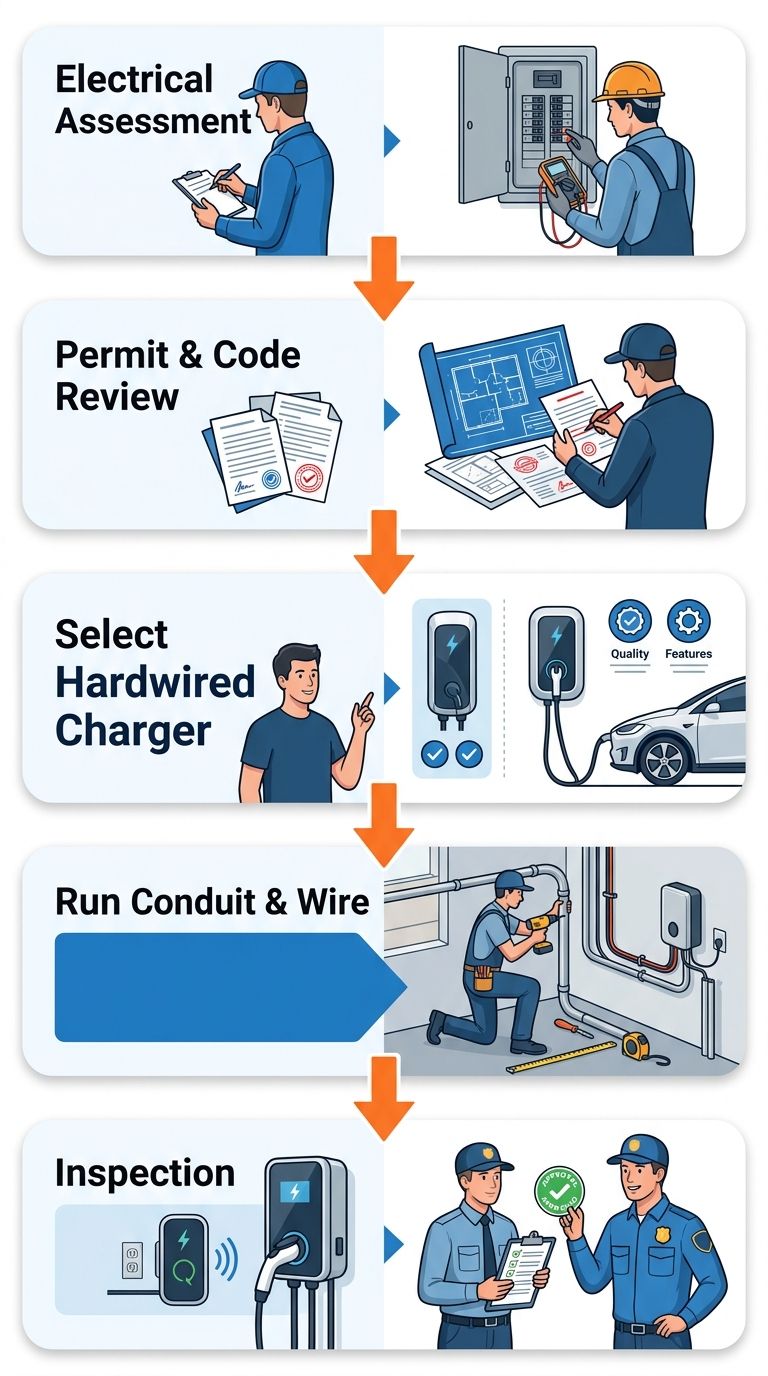
Step-by-step EV charger installation process
- Electrical Assessment & Panel Upgrade
Start by evaluating your home’s electrical panel capacity. Many Altadena houses built before 2000 rely on 100-amp panels that can’t safely handle the continuous draw of a Level 2 EV charger, and older knob-and-tube wiring can pose additional risks. Our electricians perform a detailed load calculation and recommend a panel upgrade to 200 amps when necessary, aligning with National Electrical Code 2026 mandates. - Permitting & NEC 2026 Compliance
Before any physical work begins, you must obtain a building permit from Los Angeles County (Altadena is an unincorporated area). The NEC 2026 EV charger requirements specify a dedicated circuit and GFCI protection for residential chargers; we manage the entire permitting process to keep your project on schedule and ensure it meets all local code compliance steps. - Choosing the Right EV Charger & Components
For a code-friendly installation, select a hardwired Level 2 charger — typically 40 or 50 amps. Hardwiring simplifies inspection by eliminating the need for a plug and GFCI receptacle at the unit. We supply all necessary components: a weatherproof enclosure, a matching 50-amp breaker, and rigid conduit. - Installation: Conduit, Wiring & Hardwired Connection
Our team runs EMT or PVC conduit from the panel to the charger location and pulls 6 AWG copper wire for a 50-amp circuit. The charger is securely mounted at the proper height and hardwired inside its junction box, following manufacturer specifications and NEC article 625. - Final Inspection & Permit Sign-Off
After installation, a licensed electrician performs a thorough electrical safety inspection to verify correct wiring, grounding, and device function. Los Angeles County inspectors then review the work and sign off on the permit — making your charger fully code-compliant and ready for everyday use. Contact Altadena Pro Electrician Service today for a free estimate; our trusted local electricians are available 24/7 to guide you through every step, from initial panel review to final permit approval. With our deep knowledge of 2026 NEC updates, we make sure no detail is overlooked.
Ensuring Your EV Charger Meets 2026 Code Standards in Altadena, California
Going a step further from selecting the right EV charger, it’s critical to future-proof your investment by ensuring compliance with the latest code updates. Understanding NEC 2026 EV charger requirements is essential for Altadena homeowners planning a new installation. California adopts the National Electrical Code with state-specific amendments, so the responsibilities for a safe project extend beyond simply buying the right hardware.
Compliance with these 2026 code standards involves key considerations like load management calculations, proper GFCI protection, and correctly sized conduit runs. We don’t expect homeowners to memorize technical tables; instead, our licensed electricians stay current with every local Altadena amendment and can align your installation with both state and federal guidance. According to the U.S. Department of Energy, national policies on EV charging infrastructure continue to evolve, reinforcing the importance of professional installations that follow best practices for grid integration and energy efficiency.
The most reliable path to a code-compliant EVSE installation is to request permits, schedule a final inspection, and document every step of the process with a local professional. Our team is Trusted for Exceptional Electrical Services in Altadena precisely because we handle these details for you. With code compliance handled, the next question often turns to cost — our licensed team offers transparent free estimates for your project.