
Electrical Code Requirements for ADU California: 2026 Compliance Guide
Table of Contents
- Understanding California’s 2025-2026 Electrical Code for ADUs
- The ADU Movement in Altadena and Surrounding Foothill Communities
- Electrical Services for Your ADU Project Across the Foothills
- Navigating LADBS Permits and Local Code Specifics
- How to Start Your ADU Electrical Journey
- Planning a Safe, Compliant ADU Electrical System
Understanding California’s 2025-2026 Electrical Code for ADUs
For Altadena homeowners planning an accessory dwelling unit, understanding electrical code requirements for ADU in California is essential. The California Energy Commission has released 2025-2026 updates that affect ADU installations under Title 24, the state’s Building Energy Efficiency Standards. The commission is the primary authority for energy efficiency standards in California, ensuring that all new construction, including ADUs, meets rigorous safety and efficiency benchmarks. We stay current with these changes to help our neighbors achieve full compliance.
Key provisions now require ADUs to be solar-ready and include pre-wiring for electric vehicle supply equipment. Major appliances like ranges and water heaters must have dedicated circuits, and load centers must meet code capacity requirements. Navigating these California ADU electrical code requirements can be complex, so we always recommend hiring a licensed electrician and pulling the proper permits to ensure a safe, inspection-ready installation.
The ADU Movement in Altadena and Surrounding Foothill Communities
California’s aggressive ADU legislation has sparked a construction wave across the San Gabriel foothill communities, including Altadena, Pasadena, La Cañada Flintridge, and Sierra Madre. This growth has driven demand for qualified electrical services that understand local building department nuances. As unincorporated Los Angeles County, Altadena ADU projects must comply with LADBS electrical standards, making it crucial to anticipate LADBS electrical permit fees before obtaining building permits. Meanwhile, Pasadena, La Cañada Flintridge, and Sierra Madre each enforce their own building codes that align with California’s Title 24 energy requirements yet add local nuances for solar readiness, separate metering, and panel capacity. Solar mandates under Title 24 may require photovoltaic systems for new construction ADUs, adding another layer of electrical planning. Whether you are planning a detached rental unit or a family ADU, understanding electrical code requirements for ADU California is the first step to a safe, compliant installation. ADU electrical requirements in Altadena and surrounding areas evolve, so referencing current LADBS and municipal guidelines is essential.
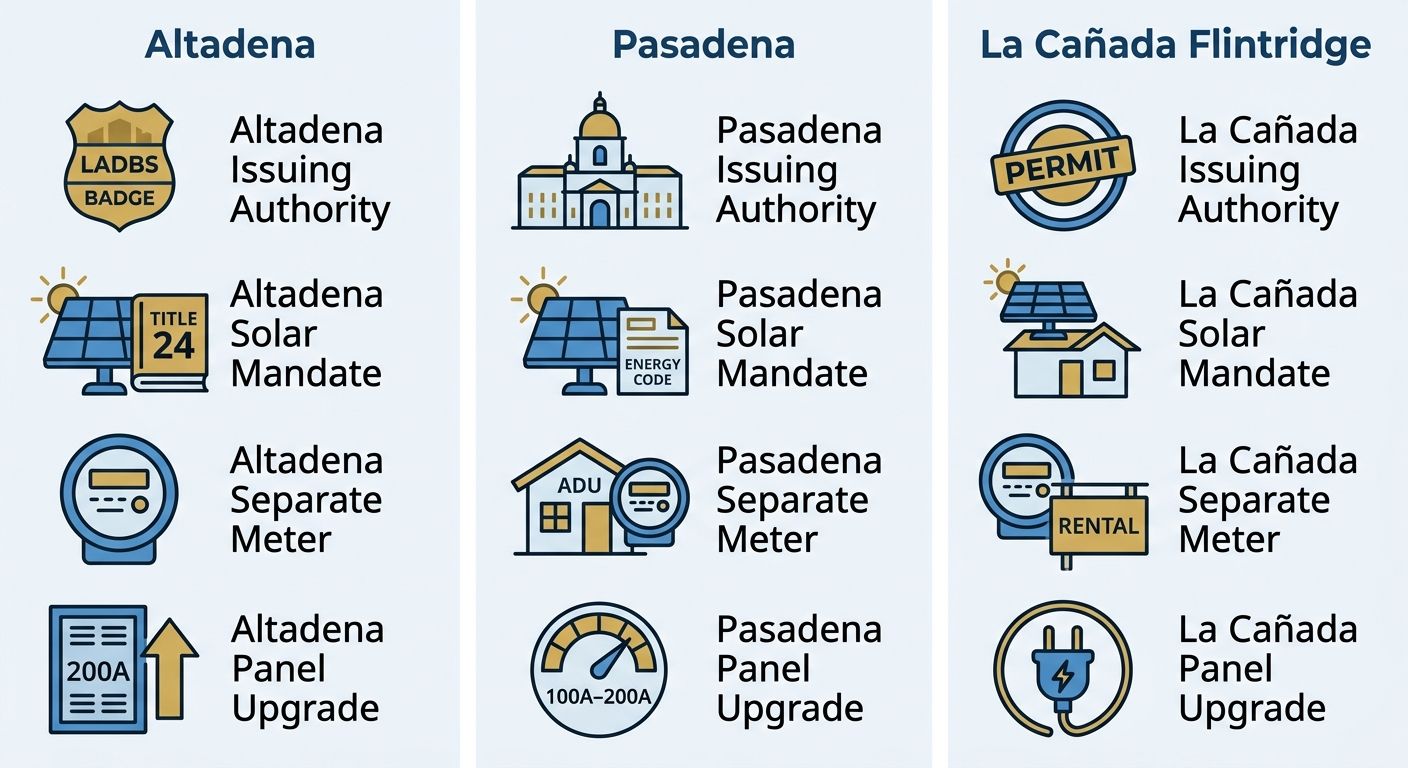
The table below contrasts key electrical requirements across the region:
| City/Area | Issuing Authority | Solar Mandate for ADUs | Separate Meter Required? | Panel Upgrade Trigger |
|---|---|---|---|---|
| Altadena (unincorporated LA County) | LADBS | Follows Title 24 – solar may be required for new construction | Generally yes for detached ADUs; consult LADBS for exceptions | When existing service cannot support the additional load (200A typical) |
| Pasadena | Pasadena Building & Safety | Aligns with state energy code; enforcement may vary | Typically required for detached units | Load calculation determines upgrade; 100A may suffice for smaller ADUs |
| La Cañada Flintridge | City of La Cañada Flintridge Building & Safety | State mandates apply; local ordinances may add guidance | Separate meter usually needed for rental ADUs | 200A upgrade common for full electrification or EV readiness |
| Sierra Madre | Sierra Madre Building & Safety | Conforms to California Energy Code; solar readiness may be required | Required for separate occupancy per LADWP/Sierra Madre guidelines | Load study dictates requirements; older homes often need panel upgrade |
Across the foothills, rules vary. Altadena (unincorporated LA County) generally requires a separate meter for detached ADUs and often mandates a 200A panel upgrade when existing service falls short. Pasadena may allow 100A for smaller units, while La Cañada Flintridge and Sierra Madre emphasize load studies or full-electrification readiness for EV charging. We recommend consulting our trusted local electricians, who are licensed and insured, to determine the exact requirements for your ADU project. Our team simplifies the LADBS permit process and ensures all panel upgrades meet local standards. For reliable code guidance and a free estimate, call (626) 768-1402. We navigate the permit maze so you don’t have to.
Electrical Services for Your ADU Project Across the Foothills
Adding an accessory dwelling unit to your property in Altadena, Pasadena, or any Foothills community in California involves more than just framing and finishes—it demands careful attention to the electrical code requirements for ADU California projects. We help homeowners navigate these demands with confidence and local expertise.
For most ADU projects, reviewing the 200 amp service upgrade requirements in California is essential to ensure your new unit has adequate power. A modern ADU with kitchen appliances, laundry equipment, and HVAC systems typically exceeds what an older 100-amp panel can safely deliver. Our licensed and insured electricians perform complete load calculations and coordinate with local utilities to bring your service up to current California ADU electrical code standards.
Permit requirements add another critical layer to the process. The Los Angeles Department of Building and Safety oversees electrical permits for foothill communities, including Altadena, La Cañada Flintridge, and Sierra Madre. Permit fees vary based on project scope and valuation, and foothill communities like Pasadena may enforce additional local amendments beyond the California Electrical Code. Our team manages the permitting process from application through final inspection, ensuring your ADU electrical work meets every requirement.
The typical electrical scope for an ADU includes a new subpanel, dedicated circuits for kitchen and laundry areas, GFCI outlets in all wet locations, and hardwired smoke and carbon monoxide detectors. Each element must satisfy stringent code requirements, which is why we handle the full installation with transparency and care.
We offer free estimates and clear communication from start to finish. As trusted local electricians serving the Foothills, we recommend that every homeowner hire a licensed electrician and obtain the necessary permits for ADU electrical work. Contact us to discuss your project and schedule a free estimate today.
Navigating LADBS Permits and Local Code Specifics
When planning an ADU electrical setup, understanding the electrical code requirements for adu California and LADBS permitting rules ensures compliance with local standards in Altadena and throughout Los Angeles County. The permit process involves a few key steps:
- Prepare required documents: a site plan, load calculation, and panel schedule.
- Submit the application through LADBS’s e-Plan portal or at a walk-in counter.
- After approval (usually 1–2 weeks), schedule the rough-in inspection for wiring and mounting, followed by the final inspection to verify system operation and cover installation.
Permit fees for a residential panel upgrade typically range from $150 to $350, depending on amperage and project scope; additional costs may apply for plan review or expediting. For detailed fee information, see LADBS electrical permit fees.
All work must conform to the California Electrical Code (Title 24) and any local LADBS amendments specific to Altadena and Los Angeles County. We manage every step — from document preparation to final sign-off — so your panel upgrade not only meets the electrical code requirements for adu California but also satisfies all LADBS permitting rules. Always hire a licensed electrician to handle permits; it prevents delays and ensures safety.
How to Start Your ADU Electrical Journey
Once you’ve decided on your ADU design, the next critical step is planning the electrical work. Understanding the electrical code requirements for an ADU in California is vital, as state regulations like Title 24 and local Los Angeles County amendments govern every detail. We recommend consulting a licensed and insured electrician early to review your property’s electrical panel capacity and anticipated load.
Your new ADU will need circuits for general lighting and receptacles throughout, dedicated outlets for kitchen appliances and bathroom fixtures, a dedicated connection for the HVAC system, and, as a forward-looking measure, pre-wiring for an electric vehicle charger. Anticipating these needs early can prevent costly panel upgrades after construction and streamline compliance with the NEC 2026 requirements for EV readiness.
Altadena Pro Electrician Service offers a free estimate to review your plans and walk you through local code requirements, helping you avoid permitting delays. As trusted local electricians who navigate Altadena’s permit process daily, we can ensure your ADU meets every standard from day one. For more information on energy-efficient ADU designs and available rebate programs, visit the Department of Energy Resources. When you’re ready to explore California’s ADU electrical codes in detail, continue to the next section.
Planning a Safe, Compliant ADU Electrical System
Understanding electrical code requirements for an ADU in California is critical to safe, compliant planning. Obtaining the necessary permits, such as LADBS building permits, is a critical step for compliance. Have a licensed electrician perform load calculations to meet electrical code requirements for an ADU in California. Integrating smart panels or subpanels supports future solar-ready setups and Title 24 compliance. Once compliance is understood, contact our licensed and insured team for a free estimate and proper installation.