
Best Whole Home Surge Protector for 2026: Top Picks
Table of Contents
- Whole Home Surge Protector: Essential Protection for Altadena Homes
- Understanding Whole Home Surge Protector Fundamentals
- Deep Dive: Appliances, Smart Homes, and Coastal Needs
- Practical Guide: Cost, Installation, and Selection Considerations
- Advanced Surge Protection for Modern Electrical Systems
- Frequently Asked Questions About Whole Home Surge Protectors
- Protect Your Home and Appliances with Professional Surge Protection
Whole Home Surge Protector: Essential Protection for Altadena Homes
A whole home surge protector is a powerful device installed directly at your main electrical panel, shielding your entire property from destructive external power surges. For homeowners in Altadena, where lightning strikes, grid fluctuations, and aging infrastructure can cause unexpected voltage spikes, this layer of defense is increasingly vital. We provide expert surge protection device installation that helps safeguard your valuable electronics, appliances, and HVAC equipment from costly damage before it occurs.
Our licensed and insured technicians understand the unique electrical demands of local properties, and we recommend an electrical panel surge protector as a foundational safety upgrade for any residence. While no device can prevent every surge-related event, whole-home protection dramatically reduces the risk of fried circuit boards, corrupted data, and premature appliance failure. As trusted local electricians, we take a transparent, value-focused approach: we explain your options clearly, answer your questions, and never push unnecessary add-ons. This commitment to straightforward service is why Altadena residents count on us to keep their homes protected year-round.
Ready to strengthen your home’s defense against unpredictable power surges? Contact us today to book a service visit. For professional installation and a thorough assessment of your electrical system, trust our altadena electrical services. We’ll help you choose the right whole home surge protector and install it with the care your home deserves.
Understanding Whole Home Surge Protector Fundamentals
Everyday life in Altadena relies on a steady stream of electricity, yet the power grid is far from a constant, pristine flow. Minor fluctuations, known as transient voltage, occur regularly when large appliances cycle on or off. More severe events, such as a voltage spike or a surge, send a sudden burst of excess energy through the wiring — often compared to a water hammer effect in plumbing, where a valve closing too fast creates a high-pressure wave that can damage pipes. A whole home surge protector is the first line of defense, installed at the main service panel to intercept this excess voltage and safely divert it to the ground, shielding everything from living room electronics to kitchen appliances.
What is a Whole Home Surge Protector?
At its core, a whole home surge protector is a hardwired device that clamps excess voltage the moment it appears. When a transient voltage spike travels along utility lines, it seeks the easiest path to earth. The surge protector, mounted inside or adjacent to the primary electrical panel, provides that path. In a fraction of a microsecond, components like metal oxide varistors redirect harmful energy into the grounding system, preventing it from passing through the home’s branch circuits. This reaction happens silently and automatically, long before the telltale signs of a surge — flickering lights or a damaged appliance — ever appear.
For Altadena homeowners, the installation of a whole home surge protector is a proactive step that helps protect the full suite of modern electronics, from smart thermostats to entertainment systems. These protective devices are engineered to meet stringent UL 1449 safety standards, ensuring they can handle the demanding conditions introduced by both external grid-switching events and internal, smaller surges from equipment within the dwelling.
Whole Home Surge Protector vs. Electrical Panel Surge Protector
Many residents ask about the difference between a whole home surge protector and an electrical panel surge protector, and the answer largely comes down to terminology. In practice, the two terms are used interchangeably. Both refer to a device that protects the home at the point where electricity enters. An electrical panel surge protector is, however, the more precise name for a Type 2 surge protection device (SPD) that is installed directly into the load center or main breaker panel by a licensed altadena electrician company.
Regardless of what label is used, the goal remains the same: to create a barrier that stops surges before they can spread through the intricate web of circuits behind your walls. Understanding this clarification allows homeowners to focus on the correct protection level for their specific needs, knowing that professional surge protection device installation in Altadena is a reliable path to a more resilient electrical system.
Types of Surge Protection Devices
To choose the right defense, it helps to understand the three main categories defined by UL 1449 and the National Electrical Code. Type 1 surge protectors are the heavy-duty first responders, permanently connected at the service entrance ahead of the main disconnect. They are rated to handle very large surges, including those generated by nearby lightning strikes. Type 2 units, which are the most common permanent solution for residential use, are installed at the load center to mitigate medium surges that originate from utility grid switching. Finally, Type 3 devices provide the last line of defense at the point of use — the familiar plug-in power strips that protect a single, individual device.
The following comparison provides a detailed technical visualization of how a layered defense is constructed:
| Feature | Type 1 | Type 2 | Type 3 |
|---|---|---|---|
| Installation Location | Service Entrance / Main Panel | Load Center / Subpanel | Point of Use (Outlet Plug-in) |
| Primary Application | Very large surges (lightning) | Medium surges (grid switching) | Small surges (internal devices) |
| Protection Scope | Whole home / main disconnect | Whole home / branch circuits | Individual device only |
This layered approach, where a Type 1 or Type 2 device handles the heavy lifting while Type 3 units add localized precision, is recommended by industry standards to reduce the risk of equipment damage. For Altadena homes, pairing a robust hardwired solution with sensitive point-of-use strips creates a comprehensive shield.
Deep Dive: Appliances, Smart Homes, and Coastal Needs
Now let’s dive deeper into how whole home surge protection applies to specific scenarios in your home. As trusted local electricians, we regularly encounter situations where a comprehensive surge protection device installation makes a measurable difference for our customers’ property and peace of mind.
Protecting Major Appliances from Grid Fluctuations
Modern major appliances like refrigerators, HVAC systems, washers, and dryers rely on sensitive electronic control boards that can be damaged by power surges, voltage sags, and other grid fluctuations. A whole home surge protector, also known as an electrical panel surge protector, is installed at your main electrical panel. It monitors incoming voltage and diverts excess energy to the ground before it reaches your valuable appliances, significantly reducing the risk of expensive failures. According to the U.S. Department of Energy, maintaining a stable electrical infrastructure is essential for residential energy reliability. Our licensed and insured electricians install UL 1449-listed protectors to ensure full code compliance and manufacturer compatibility.
Whole Home Surge Protector for Modern Smart Homes
A modern smart home contains dozens of low-voltage microprocessors inside WiFi routers, smart thermostats, security cameras, and entertainment centers. These sensitive components are far more vulnerable to even small voltage spikes than traditional appliances, making whole home surge protection essential rather than optional. We recommend layered protection for smart homes: a Type 2 whole home surge protector at the main panel to stop large external surges, combined with Type 3 point-of-use protectors at outlets powering especially sensitive or expensive equipment. Our team assesses your smart home setup and installs both levels of protection, providing a firm written quote tailored to your specific devices and electrical layout.
Coastal Home Considerations: Palos Verdes and Beyond
Coastal homes in communities like Palos Verdes face heightened electrical risks that inland properties rarely encounter. Lightning strikes occur more frequently along coastal corridors, and persistent salt-air corrosion slowly degrades electrical connections, panels, and grounding systems. Installing a whole home surge protector helps protect against lightning-induced surges while extending the lifespan of your electrical equipment in corrosive environments. For homeowners who need immediate assistance after a storm or unexpected power event, our emergency electrician in San Marino is available 24/7 to diagnose surge-related damage and restore your protection. While no device guarantees 100% protection against a direct lightning strike, a properly installed surge protector significantly reduces the risk of catastrophic damage to your appliances and smart home infrastructure.
Practical Guide: Cost, Installation, and Selection Considerations
Now that you understand the benefits of whole-home surge protection, here is a practical guide to installing a whole home surge protector—covering cost, installation, and selection. As your trusted local electricians, we’re here to help you make an informed, safe choice.
Average Installation Cost and Key Factors
The cost to install a whole home surge protector varies based on several key factors. Typically, the device itself costs between $200 and $600, while professional labor adds $150 to $400, bringing the total project range to $350–$1,000. Important cost drivers include:
- Panel age and amperage: Older panels or those with limited capacity may require an upgrade before installation, which can add $500 to $2,000 to your total. We always assess your panel first to avoid surprises.
- Breaker requirements: Most installations need a dedicated 20-amp or 30-amp two-pole breaker, influencing material costs.
- Location and accessibility: Permit fees and how easy it is to reach your panel can affect labor charges.
We provide firm written quotes after a thorough assessment of your home’s electrical system. Professional installation not only ensures safety but also helps you avoid unexpected expenses down the line.
Professional Installation Process and Code Requirements
Our licensed electricians follow a structured, safe process for surge protection device installation:
- Shut off main power and verify the absence of voltage.
- Mount the surge protector device on a wall near the panel or on an available knockout.
- Connect the device to a dedicated 20-amp or 30-amp two-pole breaker as specified by the manufacturer.
- Test the installation by restoring power and confirming indicator lights show active protection.
- Label the installation for future maintenance and inspection.
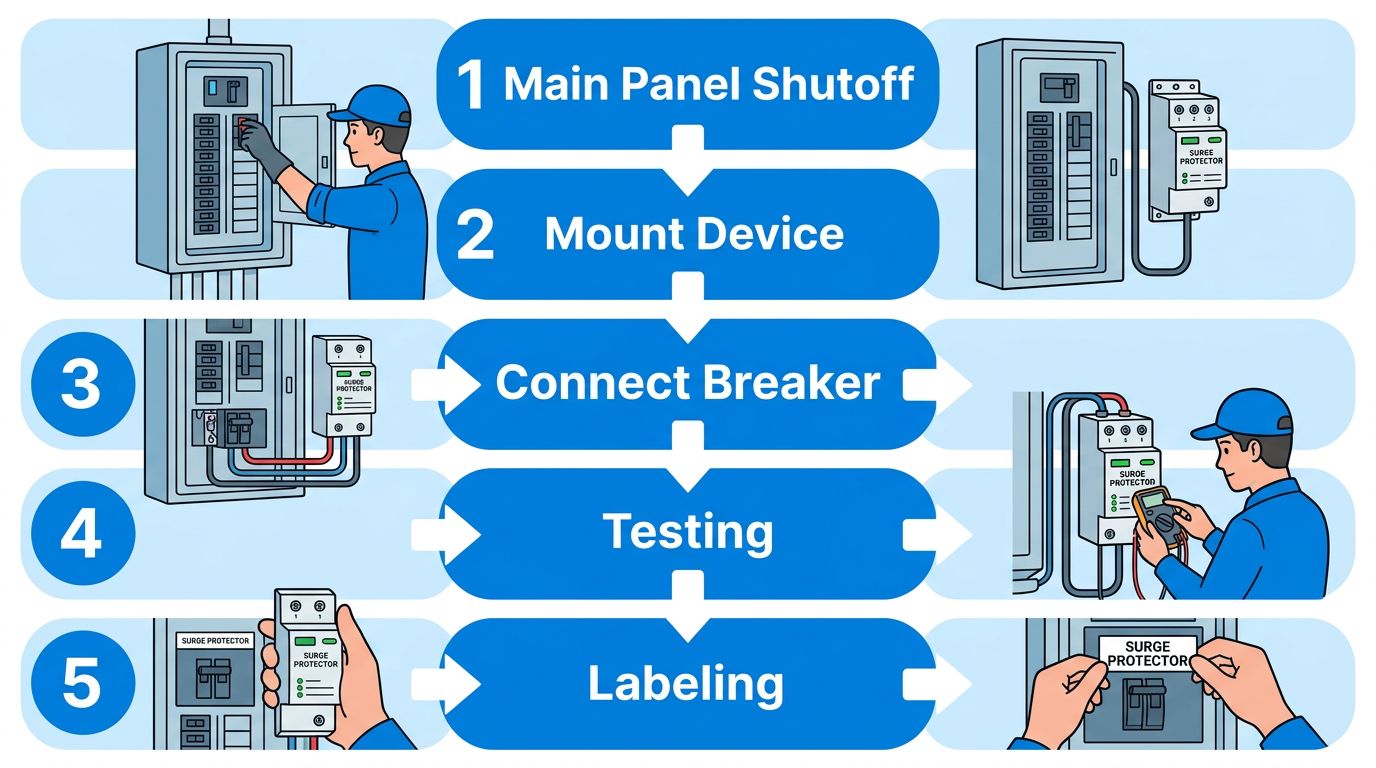
Surge protector installation process in five clear stages
NEC 230.67 mandates that all new or upgraded service panels include surge protection; failure to comply can void your insurance coverage. We recommend hiring a licensed electrician and obtaining necessary permits—our team is licensed and insured to ensure your installation meets every code requirement.
Choosing the Right Surge Protector for Your Home
- Type vs. location: Type 1 SPDs connect at the meter base and offer whole-house protection before the main breaker, ideal for homes with limited panel space; Type 2 SPDs mount directly to the main panel and are the most common residential solution.
- Surge capacity: Look for a surge current rating of at least 50,000 amps and a joule rating exceeding 1,000 to handle substantial surges.
- Local grid conditions: Coastal areas (like those near the ocean) may require higher MOV ratings to combat frequent line surges; lightning-prone zones need higher surge current capacity.
- Smart home complexity: Homes with sensitive electronics or extensive smart systems benefit from layered protection using both Type 1 and Type 2 devices.
Our experts can help you match your panel type and local conditions to the right solution.
Common Installation Mistakes to Avoid
- Undersized joule rating: A low-rated surge protector fails prematurely under frequent surges, leaving appliances vulnerable.
- Relying on point-of-use protectors only: Plug-in units do not shield major appliances or your electrical panel.
- DIY wiring errors: Incorrect breaker sizing, loose connections, or improper bonding cause overheating and fire risks.
- Skipping professional installation: Many manufacturer warranties require a licensed electrician, and self-installation often violates local codes.
- Ignoring NEC 230.67: Non-compliance can lead to insurance denials if a surge-related incident occurs.
If an electrical emergency arises during installation, our trusted local electricians are available 24/7—call an Emergency Electrician in San Marino for immediate assistance.
Advanced Surge Protection for Modern Electrical Systems
For more robust defense than what basic power strips can offer, advanced whole home surge protection represents a significant next step in safeguarding modern electrical systems in Altadena homes. A whole home surge protector — sometimes called a surge protective device, or SPD — is installed directly at your main electrical panel. This strategic placement shields every circuit and the appliances and electronics connected to them from damaging external and internal power surges.
Smart Surge Protectors with Monitoring Features
Modern whole home surge protectors have evolved far beyond simple surge suppression. We now install smart models that provide real-time voltage monitoring, remote alerts via smartphone apps, and detailed energy consumption data. These intelligent devices log every surge event, giving you a clear history of your home’s electrical health. If a problem develops, the system can notify you immediately, allowing for proactive response that significantly reduces the risk of damage to expensive equipment. For Altadena homeowners investing in high-end appliances and smart home technology, this level of monitoring delivers valuable peace of mind and helps protect your investment against the unpredictable nature of grid fluctuations and lightning strikes.
Integration with Electrical Panel Upgrades and Home Energy Systems
Surge protection becomes even more powerful when integrated with other electrical improvements. During an electrical panel upgrade, adding a whole home surge protector is a cost-effective addition that provides comprehensive coverage for your newly modernized system. We frequently recommend this combination to Altadena customers who are already planning panel work, as the installation is efficient and the protective benefits are immediate. An electrical panel surge protector also integrates seamlessly with generator transfer switches, safeguarding generator-powered circuits during grid switching or generator operation. For homes with solar systems, whole-house surge protection is essential for protecting sensitive and expensive solar inverters from surges caused by lightning or utility grid fluctuations, forming a cohesive, whole-home defense strategy.
Maintenance and Replacement of Surge Protection Devices
To ensure your surge protection device installation continues to perform, regular maintenance is necessary. We advise homeowners to perform simple monthly checks:
- Indicator Lights: Check the status lights on the unit. A solid green light typically means it is functioning correctly, while a red light signals the device has reached its capacity and needs replacement.
- Testing: Many units have a built-in test button; use it periodically to verify operational status.
- Replacement Interval: Plan to replace your surge protective device every 5 to 10 years, or immediately after a known major surge event, such as a nearby lightning strike.
Surge protection device installation and replacement should always be performed by a licensed electrician to ensure code compliance and safety. As trusted local electricians, we recommend hiring a licensed electrician and obtaining necessary permits for electrical work. At Altadena Electricians, our licensed and insured team is ready to help, and we provide a firm written quote for your whole-home protection needs.
Frequently Asked Questions About Whole Home Surge Protectors
1. What is a whole home surge protector? A whole home surge protector is a device installed directly into your electrical panel that shields your entire home’s appliances and devices from voltage spikes.
2. How does a whole home surge protector work? This type of electrical panel surge protector detects excess voltage and safely diverts it to the ground before it can damage your sensitive electronics.
3. What are the benefits of installing a whole home surge protector? Professional surge protection device installation can help protect electronics, prevent costly repairs, and provide real peace of mind for homeowners across the area.
4. How much does installation cost? As trusted local electricians, we offer this service as an affordable investment for your home’s safety and provide a firm written quote. We are licensed and insured, and we recommend hiring a licensed electrician and obtaining necessary permits for electrical work.
Protect Your Home and Appliances with Professional Surge Protection
A whole home surge protector is one of the most effective ways to shield sensitive electronics and major appliances from the damage that sudden power surges can cause. We install an electrical panel surge protector that intercepts high-voltage spikes before they spread through your wiring, offering cost-effective protection for every connected device in the house. As trusted local electricians who are licensed and insured, we ensure your surge protection device installation is properly grounded, meets all California electrical codes, and will deliver reliable, long-term defense for your home. Reach out to our team for peace of mind and a firm written quote on whole-house surge protection in Altadena.
Resources
- Reliable 24/7 Electrical Services for Altadena
- Licensed Electrician for Altadena and Surrounding Areas
- 24/7 Emergency Electrician Service in San Marino
- Choose Licensed Local Electrician in South Pasadena
- Expert Electrical Upgrades for South Pasadena Homes
- Complete Electrical Services for San Marino Residents
- Discover Benefits of Local Electrician in Altadena
- Explore U.S. Department of Energy Programs and Research
More Questions
Can a Whole Home Surge Protector Save My Appliances from Grid Fluctuations?
Yes, a whole home surge protector (also known as an electrical panel surge protector) is specifically designed to save your appliances from grid fluctuations and voltage spikes.
Modern major appliances—such as refrigerators, HVAC systems, washers, and dryers—rely on sensitive electronic control boards. These components are highly vulnerable to damage from power surges and grid fluctuations. A whole home surge protector helps in the following ways:
- Voltage Monitoring: The device is installed at your main electrical panel where it monitors incoming voltage in real-time.
- Energy Diversion: When it detects a transient voltage spike or a surge from the utility grid, it intercepts the excess energy and safely diverts it to the ground in a fraction of a microsecond.
- Comprehensive Shielding: Unlike point-of-use power strips, this device shields every circuit in your home, preventing harmful energy from reaching your appliances’ delicate circuitry.
- Layered Defense: Experts recommend a “layered” approach. This involves a Type 2 device at the main panel to stop large external surges and Type 3 point-of-use protectors for individual, highly sensitive equipment.
Professional installation by a licensed electrician is essential to ensure the device is properly grounded and compliant with NEC 230.67 codes, which often validate manufacturer warranties and insurance coverage.
Which Whole Home Surge Protector Brand Is Best for Modern Smart Homes?
For modern smart homes that contain sensitive microprocessors in devices like WiFi routers, smart thermostats, and security cameras, the best approach is layered protection. Based on technical specifications, several leading brands are highly effective:
- Square D HEP80: This model is a top choice for high-value protection, offering the highest Joule Rating (1800 J) and a substantial $75,000 connected equipment warranty.
- Eaton CHSPT2ULTRA: Provides robust protection for modern systems with a $75,000 warranty and a low Clamping Voltage of 600 V, which helps protect sensitive electronics.
- Siemens FS140: A reliable option with a 1080 J rating and a $50,000 warranty, suitable for general residential smart home setups.
- Leviton 51110-1: Another quality contender with a 600 V clamping voltage and $50,000 warranty.
Key Considerations for Smart Homes:
- Layered Defense: Smart homes benefit most from a Type 2 whole home surge protector installed at the main panel to stop external surges, combined with Type 3 point-of-use protectors (power strips) at outlets for specifically expensive equipment.
- Response Time: All these leading brands offer a response time of <1 ns, which is critical for protecting fast-acting electronic components.
- Monitoring Features: Some advanced modern models now include real-time voltage monitoring and smartphone app alerts, which are ideal for tech-heavy households.
How Does a Whole Home Surge Protector Differ from a Standard Power Strip?
A whole home surge protector (Type 1 or Type 2) and a standard power strip (Type 3) differ significantly in their installation location, the scope of protection they provide, and the types of surges they are designed to handle.
Key differences include:
- Installation Location: A whole home surge protector is a hardwired device installed directly at your main electrical panel or service entrance. In contrast, a standard power strip is a point-of-use device that plugs into a standard wall outlet.
- Scope of Protection: Whole home units shield the entire property, including the electrical panel, branch circuits, and major hardwired appliances (like HVAC systems and refrigerators). Power strips only protect the individual devices plugged directly into them.
- Surge Capacity: Whole home protectors are the first line of defense, engineered to intercept large external surges from lightning strikes or utility grid switching. Power strips are designed to mitigate much smaller, internal surges caused by devices within the home cycling on and off.
- Layered Defense: Industry standards recommend a layered approach. A whole home unit handles the “heavy lifting” by diverting high-voltage spikes to the ground, while power strips provide localized precision for sensitive electronics like computers and smart home equipment.
What Is the Average Cost to Install a Whole Home Surge Protector?
The total cost to install a whole home surge protector typically ranges from $350 to $1,000. This estimate is comprised of two main components:
- The Device: High-quality surge protection devices generally cost between $200 and $600.
- Professional Labor: Hiring a licensed electrician for the installation usually adds $150 to $400 to the total.
Several variables can affect the final price of your installation:
- Panel Age and Amperage: If your electrical panel is older or has limited capacity, it may require an upgrade before a surge protector can be installed. This can add $500 to $2,000 to the project cost.
- Breaker Requirements: Most installations require a dedicated 20-amp or 30-amp two-pole breaker, which influences the cost of materials.
- Location and Accessibility: Labor charges may increase depending on how easy it is to reach the panel and any required permit fees.
It is highly recommended to hire a licensed and insured electrician for this service. Professional installation ensures the device is properly grounded and meets NEC 230.67 code requirements. Additionally, many manufacturer warranties for connected equipment require proof of professional installation to remain valid.