
AFCI vs GFCI Breaker Requirements: The Complete 2026 Guide
Table of Contents
AFCI and GFCI Breaker Requirements Explained
Understanding afci vs gfci breaker requirements is essential. GFCI (ground-fault) devices protect people from shock by sensing small leakage currents, as little as 6mA, in wet locations like bathrooms, kitchens, garages, and outdoor areas. AFCI (arc-fault) breakers prevent electrical fires by detecting dangerous arc signatures from damaged wiring or loose connections. Modern residential codes, including the National Electrical Code and California amendments, mandate both types of protection in specific rooms. As trusted local electricians, we help homeowners ensure every required circuit meets current safety standards. A GFCI can be installed as an outlet or a breaker, and a correctly wired GFCI outlet safeguards all downstream receptacles on the same circuit. While both devices improve electrical safety, they address different hazards—the next section explains how these protections compare.
1. AFCI vs GFCI: The Core Differences
An AFCI (Arc-Fault Circuit Interrupter) protects against electrical fires by monitoring the circuit for hazardous arc fault signatures, including series and parallel arcing. A GFCI (Ground-Fault Circuit Interrupter) protects people from electric shock by sensing leakage current; GFCI devices open the circuit at low thresholds of 6 mA.
The primary difference lies in their protection goals: GFCIs are designed for shock prevention, while AFCIs are designed for fire prevention. A GFCI monitors the current imbalance between the hot and neutral conductors, whereas an AFCI analyzes waveform patterns for arcing conditions. Our licensed and insured team installs both AFCI and GFCI breakers.
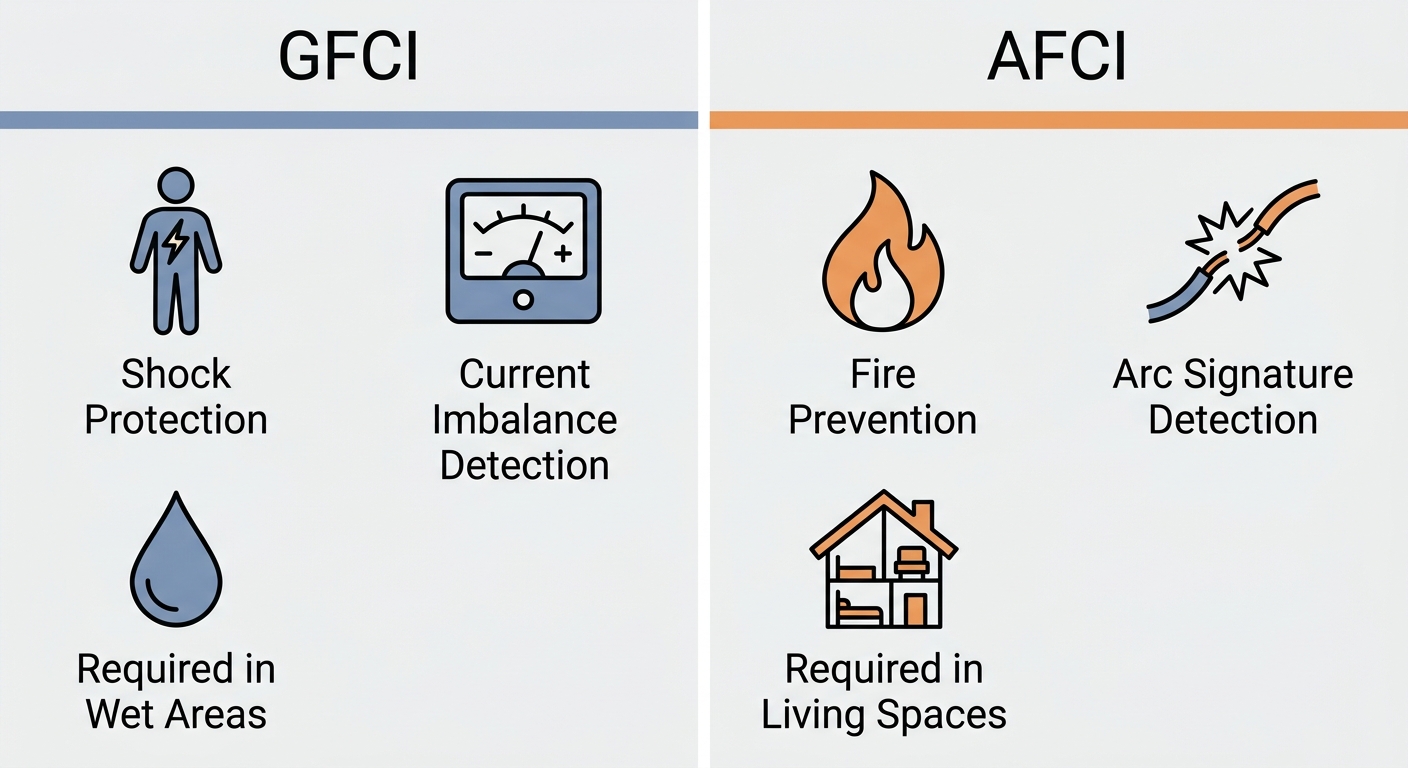
Understanding this functional distinction prepares us to examine where National Electrical Code (NEC) mandates AFCI protection in a home.
2. NEC Mandates for AFCI Breaker Locations
Arc Fault Circuit Interrupter (AFCI) breakers are designed to detect the unique electrical signatures of dangerous arc faults, a leading cause of residential fires. According to EC&M, a trusted electrical trade publication, AFCI devices protect buildings and occupants, whereas GFCI units guard against shock. The National Electrical Code (NEC) mandates this fire-prevention protection in specific areas of dwelling units. Today’s code requires AFCI breakers in nearly all 120-volt, single-phase, 15- and 20-ampere branch circuits supplying outlets in bedrooms, living rooms, dining rooms, hallways, closets, kitchens, family rooms, dens, sunrooms, recreation rooms, and laundry areas. Essentially, any habitable space where residents can plug in a cord is covered, underscoring the priority of arc-fault safety.
The 2026 NEC edition introduces refined Energy Management System and Power Control System provisions that may influence future AFCI installations. Local jurisdictions, especially California, can adopt additional amendments, so we at Altadena Pro Electrician Service recommend confirming AFCI installations meet the latest code requirements.
3. California’s AFCI Rules for Bedrooms and Living Spaces
Building on the general NEC mandates for arc-fault protection, California enforces these rules for bedrooms and living spaces. Here in Altadena, we follow the state code, which adopts the NEC and requires AFCI breakers on circuits in bedrooms, living rooms, and similar habitable areas.
AFCI breakers detect hazardous arc faults that arise from damaged wiring or loose connections. By recognizing the unique electrical signatures of arcs, they trip before a fire can start. This arc-detection technology has been a cornerstone of NEC fire safety for decades. In California, that means any new circuit or outlet installed in a bedroom, den, or family room must be AFCI-protected.
GFCI outlets and breakers, however, protect against electric shock by cutting power when they detect current leakage of just 6 milliamps—a common shock level. Kitchens, bathrooms, and outdoor areas may require both AFCI and GFCI, making dual-function breakers a practical upgrade. While AFCI breakers guard against arc-induced fires, ground-fault protection steps in where water and electricity meet.
4. GFCI Protection: A Must for Wet and Damp Areas
While arc-fault protection guards against fire risks in dry living spaces, GFCI protection prevents electric shock in wet or damp areas. GFCI outlets trip within a fraction of a second when they detect a few milliamps of current imbalance.
In California, the Electrical Code—aligned with the NEC—requires GFCI receptacles in bathrooms, kitchens (within 6 feet of a sink), garages, unfinished basements, crawl spaces, laundry rooms, and all outdoor outlets. One GFCI outlet wired at the start of a circuit can protect downstream receptacles.
We recommend monthly testing using the TEST and RESET buttons and replace outdated two-prong receptacles with code-compliant GFCI devices throughout Altadena and the foothill communities. Our licensed, insured team offers free estimates and a satisfaction promise on every GFCI outlet installation.
Whether upgrading a single bathroom outlet or planning a whole-home renovation, proper GFCI protection is a non-negotiable safety measure. Dual-function AFCI/GFCI breakers consolidate both arc-fault and ground-fault protection into one device, simplifying panel requirements while meeting California’s standards.
5. Dual-Function AFCI/GFCI Breakers for Renovations
While GFCI protection is essential in damp areas, many renovation projects also require AFCI protection, making dual-function breakers an integrated solution. A dual function AFCI/GFCI circuit breaker combines shock protection from a GFCI with fire prevention from an AFCI in a single device.
GFCI breakers detect leakage current as low as 6 mA to safeguard people from electric shock, while AFCI breakers recognize hazardous arc-fault patterns that can ignite fires, as noted by ECM (Electrical Construction & Maintenance). For homes where both protections are mandated, these breakers save panel space and simplify installation by reducing the total number of breakers in an upgraded panel.
The 2026 NEC now requires arc-flash warning labels to include the date of the incident energy or PPE category calculation. In our experience helping Altadena homeowners with electrical remodeling, we have found dual-function breakers streamline code compliance and deliver efficient shock-and-fire protection within a single unit.
That foundation makes it easier to understand the broader residential branch circuit protection requirements that follow.
6. Decoding NEC Residential Branch Circuit Protection
While dual-function breakers simplify installations during renovations, grasping the NEC residential branch circuit protection rules helps homeowners and contractors make safer, code-compliant decisions. Our team applies these NEC requirements in Altadena and neighboring foothill communities.
GFCI devices protect people from electric shock by detecting leakage current as low as 6 milliamps. GFCIs open the circuit instantly, preventing injury in wet locations.
AFCI breakers recognize dangerous arc fault signatures that can start fires; they do not provide shock protection but are required in living areas to prevent arc-induced fires. Many circuits need both protections—a dual-function breaker meets the requirement.
The 2026 NEC introduces changes that affect branch circuit planning: new energy management system definitions, more detailed arc-flash warning labels, and clarified equipment clearance angles. These updates influence how electricians design panels. For Altadena homeowners, knowing whether a circuit needs GFCI, AFCI, or both protections directly shapes the budget for a panel upgrade—a natural lead-in to comparing breaker costs.
7. AFCI vs Standard Breakers: Cost Analysis
After understanding NEC branch circuit protection, the core difference between AFCI and standard breakers is that AFCI breakers add arc-fault detection for fire prevention, while standard breakers only protect against overloads and short circuits. AFCI devices detect arc fault signatures that can ignite electrical fires, making them a critical safety upgrade. This is especially important in older Altadena homes where aging wiring can develop arc faults, a risk standard breakers can’t address.
The price difference between AFCI and standard breakers isn’t fixed — it depends on brand, circuit type, and local market conditions in Altadena. AFCI protection significantly reduces the risk of electrical fire. With these cost factors in mind, consulting a licensed electrician helps you select the breaker for each circuit while staying fully code compliant. We’re ready to assist you in making the right choice for your home’s electrical safety.
8. Hiring a Licensed Electrician for Code-Compliant Installations
Once you have selected the right AFCI or GFCI breaker, proper installation by a licensed electrician is essential. A qualified electrician in Altadena helps ensure the work meets California’s strict safety and code requirements.
In California, GFCI protection is mandatory in bathrooms, kitchens, garages, laundry rooms, outdoor areas, and any receptacle within six feet of a sink or shower. Our licensed electricians follow the California Electrical Code to the letter, installing GFCI devices in all required locations and wiring them to protect downstream outlets. A correctly placed GFCI can safeguard multiple outlets on the same circuit. For older homes with two-prong outlets, upgrading to a GFCI outlet provides ground-fault protection without a ground wire—a safe, code-approved solution.
Monthly testing using the TEST and RESET buttons verifies GFCI functionality. Our electricians serving Altadena and nearby foothill communities walk you through this test and highlight warning signs during installation. Our team delivers the expertise needed to keep your electrical system safe and up to code.
Stay Code-Compliant with Professional Electrical Services
Choosing a licensed electrician is the cornerstone of staying compliant with California’s electrical code. Understanding afci vs gfci breaker requirements clarifies that GFCI outlets are mandatory in wet areas like bathrooms and kitchens, per our service guide, to prevent shock and should be tested monthly, while AFCI devices protect against arc faults to prevent fires; ECMWeb notes that the 2026 NEC updates include revised arc-flash labels and equipment clearance rules. For all code-related upgrades, from outlet replacement to panel work, we offer a free estimate at (626) 768-1402. Trademarks cited on this website are the property of their respective owners; brand names used for identification only. We recommend hiring a licensed electrician and obtaining necessary permits for electrical work.
Get Your Free Estimate Today
Now that you’ve mastered the AFCI vs GFCI breaker requirements for 2026, it’s time to put that knowledge into action. Our licensed electricians at Altadena Pro Electrician Service are ready to assess your home’s electrical safety with a free, no-obligation estimate. We specialize in code-compliant installations of dual-function breakers, panel upgrades, and whole-home wiring. Protecting your family from shock and fire hazards is our top priority. Serving homes in Altadena, Pasadena, and nearby foothill communities, we provide transparent fixed-price quotes. Schedule your consultation today by phone or our online contact form.